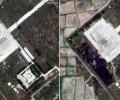
The attacks against the Pakistani air force have taken them at least five years back and caused great damage to them and their Chinese and Turkish inventory of weapons.
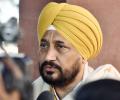
Congress MP and former Punjab Chief Minister Charanjit Singh Channi stoked controversy by demanding proof of the surgical strikes carried out by the Indian armed forces in Pakistan territory in the past under the Bharatiya Janata Party government at the Centre.

Dhoni's two-week stint with his unit was approved by the Army headquarters last week on his request.
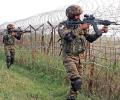
This marked the sixth consecutive night of ceasefire violations by Pakistan along the LoC, amidst heightened tensions between New Delhi and Islamabad following a recent terror attack in Pahalgam on April 22.

A villager was killed and three others were injured in shelling by Pakistan in forward areas of Jammu and Kashmir's Poonch and Rajouri districts early Friday morning, prompting Army troops to retaliate. The shelling also caused significant damage to property, with many houses and hundreds of vehicles affected. The firing and shelling were directed at areas in Rajouri, Poonch, and Jammu districts, apart from Kashmir's Kupwara and Baramulla districts, overnight.
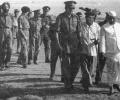
In what was perhaps the most critical meeting before full-scale war broke out, Shastri defined India's immediate war objectives to his defence minister, army, and air force chiefs: 'To defend against Pakistan's attempts to grab Kashmir by force and to make it abundantly clear that Pakistan would never be allowed to wrest Kashmir from India; To destroy the offensive power of Pakistan's armed forces...' A fascinating excerpt from Shiv Kunal Verma's must-read 1965: A Western Sunrise India's War With Pakistan.
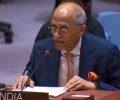
India strongly rejected Pakistan's 'unwarranted aspersions' over United Nations processes and attempts to deflect attention from atrocities committed against children in the country and rampant cross-border terrorism, asserting that the world has not forgotten the Pahalgam attacks.
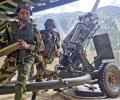
'Will this near-war, India's strongest military response so far, buy India another seven years of deterrence?' asks Shekhar Gupta.

'America holds about 16% of IMF voting rights, giving it crucial influence over Pakistan's desperately needed bailout loans.'

The incident occurred on Monday night when the victim, Mohammad Razaq (40), came out of a mosque in his village Kunda Top under the Thanamandi police station area. Razaq's brother, Mohammad Tahir Choudhary, is a soldier in the Territorial Army, police said.
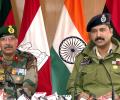
Officials have also written to the Pakistan side regarding the medicines, an official statement said.

A Pakistani intruder was also killed in the exchange of fire, they added.
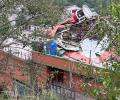
The military also claimed that 40 civilians, including seven women and 15 children, were killed and 121 others injured in strikes by India on the night of 6-7 May.
'War is not an answer. War is not a solution.' 'Deterrence is a solution. We should have the stick with us with which we can beat Pakistan.'

Bookstore owners were cautioned against keeping or distributing the books. Police personnel briefed the bookstore owners about the legal consequences of violating the ban.
'This reluctance to respond forcefully to Chinese PLA provocations and outright aggression has as much to do with Prime Minister Modi personally, as with the institutional mindset of the MEA or even the Indian Army.' 'They are scarred by the 1962 War and are still cowed by China.'

Russian and Ukrainian negotiators convened in Istanbul on Friday for their first direct peace talks in over three years, amidst pressure from US President Donald Trump to resolve Europe's deadliest conflict since World War Two.
'Had Haji Pir and/or Skardu been taken, the message would have gone out not just to General Asim Munir and his cohort in the Pakistan army but to the Pakistani people that every terrorist incident in India would lead to substantial loss of territory in PoK.'
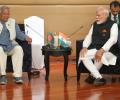
A former Bangladesh army officer and close aide of Chief Adviser Muhammad Yunus has suggested that Dhaka should collaborate with China to occupy India's northeastern states if it attacks Pakistan in response to the Pahalgam terror attack. Bangladesh's interim government has distanced itself from the remarks made by Major General (Retd) ALM Fazlur Rahman on his social media account. Rahman's comments come amidst growing tensions between India and Bangladesh following Yunus' remarks in China about India's northeastern states being landlocked and needing Bangladesh's access to the ocean. These incidents have further strained relations between the two countries, with India withdrawing transhipment facilities granted to Bangladesh for exporting goods to the Middle East, Europe, and various other countries.
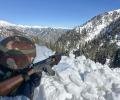
The exchange of fire occurred even though the directors general of military operations of India and Pakistan spoke over the hotline on Tuesday amid rising tensions between the two countries over the Pahalgam terror attack on April 22.
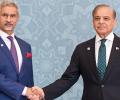
Addressing a special 'Youm-e-Tashakur' event at the Pakistan Monument in Islamabad, Shehbaz said that India and Pakistan fought three wars and got nothing.

'Pakistan's only concern has been while they were on the FATF watch list was to distance their State institutions and organs from any direct connection with the actual execution of militancy inside Kashmir.'
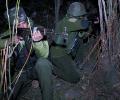
For the ninth consecutive night, Indian and Pakistani troops engaged in small arms fire along the Line of Control (LoC) in Jammu and Kashmir, continuing a pattern of heightened border tensions. The skirmishes, initiated by Pakistani troops in violation of the ceasefire agreement, have led to a tense situation along the LoC and International Border (IB). The incidents come in the wake of the April 22 terror attack in Pahalgam, which claimed the lives of 26 people, mostly tourists. Civilians residing near the border have begun preparing their bunkers, anticipating potential escalation. Despite a recent hotline conversation between the Directors General of Military Operations (DGMOs) of India and Pakistan, where India cautioned Pakistan, the ceasefire violations persist.

Ukrainian forces conducted large-scale drone strikes on several air bases deep inside Russia, destroying multiple combat planes, Ukrainian Security Service (SBU) said on Sunday.
'India has been preparing for the last 15 days... it won't be easy for Pakistan if it tries to dominate escalation.'

'I am pleased to announce the Governments of India and Pakistan have agreed to an immediate ceasefire and to start talks on a broad set of issues at a neutral site.'
'It could take the form of sporadic LoC violation through heavy artillery and mortar fire, focusing on border villages where the Hindu Dogra population is predominant.'

Syed Firdaus Ashraf marches through time to trace the bitter history between Russia and its West European neighbours.
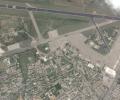
Pakistan's Prime Minister Shehbaz Sharif admitted that India's ballistic missiles hit Nur Khan Airbase and other sites on May 10, a rare acknowledgement that contradicts Pakistan's usual stance of denial when it comes to Indian military action.

Prime Minister Narendra Modi on Friday said the world has seen the power of India's indigenous weapons during Operation Sindoor, which is 'not over yet'.

The duo aspires to join 'operation all out' against terrorists in Kashmir and fight against the enemies of the nation.
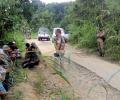
Three terrorists of the National Socialist Council of Nagaland (NSCN-K) and an Assam Rifles (AR) officer were killed in an encounter in Mon district of Nagaland, a defence spokesman said on Wednesday.

Giving details of how she silenced three hostile posts resorting to unprovoked firing on her position during Operation Sindoor, she said, "I had three posts falling in my area. I pinned down the people at all three hostile locations. We hit them with every weapon we had. They were forced to flee their posts."

The Pahalgam massacre highlights the evolution of terrorism into a multi-domain challenge. India's response must similarly evolve -- from tactical retaliation to comprehensive strategic deterrence. To establish a credible and sustained deterrent, India must also carry out continuous kinetic operations, both overt and covert, suggest Sakshit Raina and Rahul Mishra. To establish a credible and sustained deterrent, India must also carry out continuous kinetic operations, both overt and covert, suggest Sakshit Raina & Rahul Mishra.

The CII Business Summit 2025's inaugural session witnessed a rousing standing ovation and a felicitation ceremony for the defence top brass sending a strong message about India's rising military industrial complex and hghlghting that security is a top-of-the-mind issue for India Inc.

India's Republic Day parade featured a tri-services tableau showcasing the country's increasing focus on enhancing synergy among its armed forces. The tableau, themed "Shashakt aur Surakshit Bharat" (strong and secure India), displayed a battlefield scenario with indigenous military equipment, including the Arjun main battle tank, Tejas MKII fighter aircraft, and the destroyer INS Visakhapatnam. The display highlighted the Ministry of Defence's commitment to boosting tri-services synergy and jointness in preparation for future conflicts.

Kabir, the son of Col Manpreet Singh, who was killed fighting terrorists in Kashmir, believes his father will return home after receiving the Kirti Chakra. The 10-year-old boy, who lit his father's pyre 19 months ago, clings to the hope that his father is alive and well, despite the reality of his death.

Unless Donald Trump takes a major U turn, this is possibly the beginning of the end for Trumpian politics, argues Colonel Anil A Athale (retd). Unless President Trump takes a major U turn, this is possibly the 'beginning of the end' for Trumpian politics driven by TV trp's, points out Colonel Anil A Athale (retd).

Congress leader Rahul Gandhi visited Poonch in Jammu and Kashmir, offering condolences to families affected by cross-border shelling and encouraging students who lost two classmates to the violence. During an hour-long visit, Gandhi met with students at the convent school that lost the twins, and visited families whose homes were damaged in the shelling.

'Parents are forced to provide their children to Russian re-education camps in occupied territories and in different parts of Russia, for example, in Chechnya, where Ukrainian children wearing military uniform are taught to use weapons.'
